




Keyword:Dalargin,82717-96-6,Dalargin Peptide
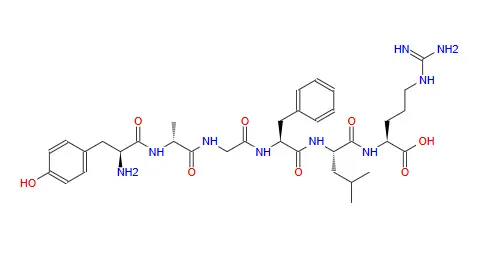
Dalargin, also known as (D-Ala2)-Leu-Enkephalin-Arg, is a synthetic hexapeptide and a modified analog of endogenous leucine enkephalin. With the CAS number 82717-96-6 and a molecular weight of approximately 696.81 Da, it is a potent dual agonist of δ and μ opioid receptors, distinguished by its enhanced stability and bioactivity due to the D-alanine modification at the 2nd amino acid position and the arginine extension at the C-terminus. Unlike natural enkephalins that are rapidly degraded in the body, Dalargin has emerged as a valuable tool in medical research and potential clinical applications, primarily focusing on analgesia, tissue repair, neuroprotection, and cytoprotection. This article details its core uses, mechanism of action, clinical research evidence, safety profile, and research prospects, supported by authoritative literature and scientific studies.
Mechanism of Action: How Dalargin Exerts Its Biological Effects
The biological activity of Dalargin is rooted in its specific binding to δ and μ opioid receptors, which are widely distributed in the central nervous system (CNS), peripheral nervous system, cardiovascular system, and immune cells. As a G protein-coupled receptor (GPCR) agonist, Dalargin binds tightly to these receptors, triggering a cascade of intracellular signaling pathways that mediate its diverse effects. Its unique structural modifications—D-alanine at position 2 and arginine at the C-terminus—play critical roles in its functionality: the D-alanine modification resists degradation by aminopeptidases, significantly extending its biological half-life, while the arginine residue enhances water solubility and improves receptor binding affinity through electrostatic interactions.
Upon receptor binding, Dalargin activates Gi/Go proteins, inhibiting adenylate cyclase (AC) activity and reducing intracellular cyclic adenosine monophosphate (cAMP) levels. This process further regulates ion channel activity, opening inwardly rectifying potassium channels (causing membrane hyperpolarization) and closing voltage-gated calcium channels (reducing calcium influx), thereby inhibiting the release of pain-related neurotransmitters such as substance P and glutamate. In non-neuronal tissues, Dalargin exerts cytoprotective and regenerative effects by activating anti-apoptotic and anti-inflammatory signaling pathways, such as the PI3K/Akt pathway, which is critical for its role in tissue repair and organ protection.
Primary Research and Clinical Applications
In analgesia research, Dalargin is a key tool for studying opioid receptor-mediated pain regulation. As a dual δ/μ agonist with higher affinity for δ receptors, it is widely used to explore the synergistic mechanisms of δ and μ receptors in central and peripheral analgesic pathways. Unlike traditional opioid analgesics that primarily target μ receptors (and carry high addiction risks), Dalargin’s preferential binding to δ receptors offers a promising direction for the development of non-addictive analgesic drugs. It has been shown to exert potent analgesic effects in animal models of chronic neuropathic pain, postoperative pain, and cancer pain, providing theoretical support for the development of novel analgesic therapies.
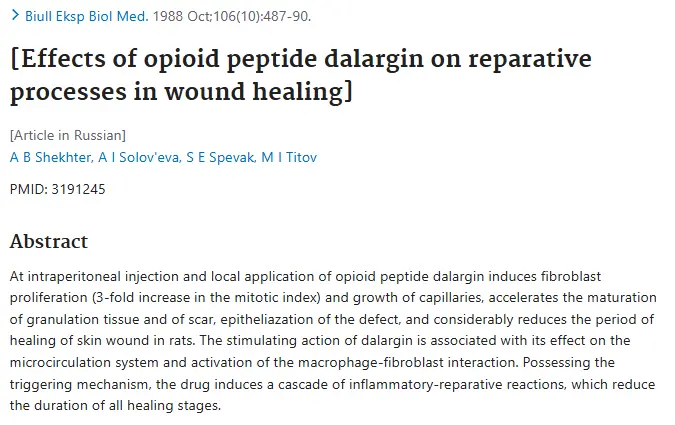
In tissue repair and wound healing, Dalargin has demonstrated significant regenerative effects. Preclinical studies in rats, dogs, and mini-pigs have shown that both intraperitoneal injection and local application of Dalargin can stimulate fibroblast proliferation (increasing the mitotic index by 3-fold), promote capillary growth, accelerate granulation tissue maturation and epithelialization, and significantly shorten skin wound healing time. Its regenerative effect is associated with improved microcirculation and enhanced macrophage-fibroblast interaction, triggering a cascade of inflammatory-reparative reactions that accelerate all stages of wound healing.
In neuroprotection, Dalargin has shown promise in the treatment of cerebral ischemia, spinal cord injury, and other neurological disorders. In mouse models of cerebral ischemia-reperfusion injury, Dalargin significantly reduces cerebral infarct size and improves neurological deficits by inhibiting neuronal apoptosis, reducing calcium overload, and suppressing the release of pro-inflammatory factors (such as TNF-α and IL-6). Its neuroprotective effect is primarily mediated by the activation of δ opioid receptors and the PI3K/Akt signaling pathway, highlighting its potential as a neuroprotective agent.
In cytoprotection and organ protection, Dalargin exhibits pronounced protective effects on the gastrointestinal tract, liver, and cardiovascular system. Experimental studies have shown that Dalargin can prevent duodenal ulcers and gastric erosions induced by stress or chemicals, reduce liver degeneration caused by CCl4 poisoning, and alleviate myocardial ischemia-reperfusion injury. In patients with coronary heart disease (CHD) and metabolic syndrome (MS), supplementary Dalargin administration significantly reduces oxidative stress parameters (such as oxidized LDL levels) and enhances antioxidant capacity (such as superoxide dismutase activity), demonstrating its potential in cardiovascular disease management.
Clinical Research and Evidence
While Dalargin is primarily used as a research tool, several clinical and preclinical studies have validated its therapeutic potential. A comparative study involving 123 patients with stable coronary artery disease and metabolic syndrome found that adding Dalargin (1 mg intranasally twice a day for 10 days, repeated for 3 courses over 3 months) to standard therapy significantly improved antioxidant capacity: superoxide dismutase (SOD) activity increased by 36.1%, total antioxidant activity (TAA) increased by 25.3%, and oxidized LDL levels decreased by 14% compared to standard therapy alone. This confirms its potential role in reducing oxidative stress in cardiovascular disease patients.
Preclinical studies have further expanded our understanding of Dalargin’s efficacy. A study published in Farmakol Toksikol demonstrated that Dalargin stimulates skin wound healing in multiple animal models at doses ranging from 0.1 to 100 μg/kg, with local and parenteral administration both showing significant effects. Another study in Biull Vsesoiuznogo Kardiol Nauchn Tsentra AMN SSSR found that Dalargin (10 μg/kg) effectively prevents ulceration in rat models of cystamine-induced duodenal ulcers and stress-induced gastric erosions, highlighting its cytoprotective properties.
Safety Profile and Administration Considerations
Dalargin’s safety profile has been well-characterized in preclinical studies and limited clinical applications. It is typically administered via intravenous, intramuscular, or subcutaneous injection, with a lyophilized powder formulation (1 mg/vial) that requires reconstitution with a diluent before use. In animal studies, the optimal therapeutic dose ranges from 0.1 to 100 μg/kg, with higher doses potentially leading to reduced efficacy (the “escape effect”).
The most common adverse effects are mild and transient, including local injection site reactions (pain, redness, swelling), transient hypotension, and mild gastrointestinal discomfort. Unlike traditional opioid analgesics, Dalargin has a lower risk of addiction due to its preferential binding to δ receptors, and no severe respiratory depression or dependence has been reported in preclinical studies. However, it is contraindicated in patients with severe hypersensitivity to Dalargin or any of its components, and caution is advised in patients with pre-existing cardiovascular or neurological disorders.
Notably, Dalargin has negligible blood-brain barrier penetration at therapeutic doses, reducing the risk of central nervous system side effects while limiting its central analgesic efficacy. This characteristic makes it more suitable for peripheral analgesia and organ protection applications, where local effects are desired.
Conclusion
In summary, Dalargin is a synthetic opioid peptide with dual δ/μ receptor agonist activity, primarily used as a research tool in neuroscience, pain medicine, tissue repair, and cardiovascular research. Its core uses include exploring opioid receptor function, investigating novel analgesic mechanisms, promoting wound healing, and protecting organs from ischemia and oxidative damage. Supported by robust preclinical evidence and limited clinical studies, Dalargin exhibits favorable safety and potent biological activity, making it a valuable tool for scientific research and a promising lead compound for drug development. While its clinical application is still in the early stages, ongoing structural optimization and mechanism research are expected to unlock its full therapeutic potential, particularly in the development of non-addictive analgesics and neuroprotective agents.