




As the "powerhouse of the cell", mitochondria continue to reveal the physiological functions of their derived peptides.Among them, MOTS-C (CAS: 1627580-64-6), a 16-amino-acid short peptide encoded by mitochondrial 12S rRNA, has emerged as a research hotspot in recent years due to its unique roles in metabolic regulation, tumor suppression and other fields.
As a retrograde mitochondrial signaling molecule, the core value of MOTS-C lies in maintaining cellular homeostasis.Studies have confirmed that it can promote the synthesis of the endogenous AMP analog AICAR and activate the AMPK signaling pathway, thereby enhancing cellular glucose uptake capacity and improving insulin sensitivity, which provides a new direction for the intervention of metabolism-related diseases. More notably is its potential in the field of aging: animal experiments have shown that MOTS-C can enhance the exercise capacity of aging individuals and extend their healthspan.This effect is achieved through the regulation of the AMPK-folate pathway, and its sequence is highly conserved across multiple species.
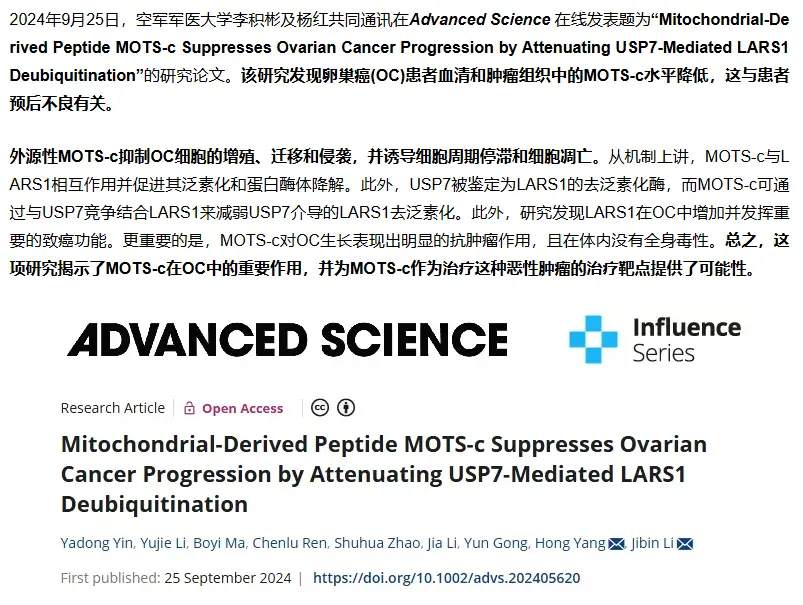
Recent research in the field of oncology has further highlighted its clinical value. A study published in *Advanced Science* by the team of Li Jibin and Yang Hong from the Air Force Medical University indicated that the levels of MOTS-C in the serum and tumor tissues of ovarian cancer patients are significantly reduced, and this indicator is directly correlated with poor prognosis. Exogenous supplementation of MOTS-C can compete with USP7 to bind LARS1, promote the ubiquitination and degradation of the latter, thereby inhibiting the proliferation and migration of ovarian cancer cells and inducing their apoptosis. It has demonstrated clear anti-tumor effects without systemic toxicity in in vivo experiments, providing a novel therapeutic target strategy for this type of malignant tumor.
MOTS-C also shows remarkable performance in the field of organ protection. Research published in *ATS Journals* revealed that it can improve metabolic reprogramming after lung ischemia-reperfusion injury by regulating the PFKFB3-AMPK-HIF1 pathway, inhibit oxidative stress and ferroptosis, and exert a protective effect against acute lung injury. The finding that its levels are decreased in patients with chronic obstructive pulmonary disease further suggests that it may be involved in the regulation of the pathological processes of pulmonary diseases.
From metabolic homeostasis to tumor intervention, from aging regulation to organ protection, the scientific research boundaries of MOTS-C (1627580-64-6) are still expanding. These research conclusions based on clinical samples and animal models not only reveal the complex mechanisms of mitochondria-nucleus communication, but also provide new exploration directions for the precision treatment of related diseases. It is expected that more in-depth studies will enable this "mitochondrial code" to unleash greater medical value.
References
1.Adv Sci: Li Jibin/Yang Hong Team. MOTS-c Suppresses Ovarian Cancer Progression via Attenuating USP7-Mediated LARS1 Deubiquitination
2.ChemicalBook. MOTS-c peptide (1627580-64-6) Physiological Function Research
3. ATS Journals. The Protective Role of MOTS-c in Acute Lung Injury