




You may not have heard of neurotensin (CAS: 55508-42-4), but this small peptide composed of 13 amino acids is emerging as a research hotspot in neuroscience and metabolism. It not only resides in neural pathways to regulate the reward of eating, but also exists in adipose tissue to affect thermogenic metabolism. Two recent studies published in top journals have just unlocked the codes to its dual functions.
First, a 2025 study in Nature revealed that obese mice on a long-term high-fat diet (HFD) fall into a vicious cycle: they prefer high-fat foods yet lack motivation to obtain them in scenarios requiring effort. The research team identified a key mechanism: neurotensin acts as the core signaling molecule encoding the "reward of eating" in the reward pathway from the lateral nucleus accumbens to the ventral tegmental area (NAcLat→VTA).
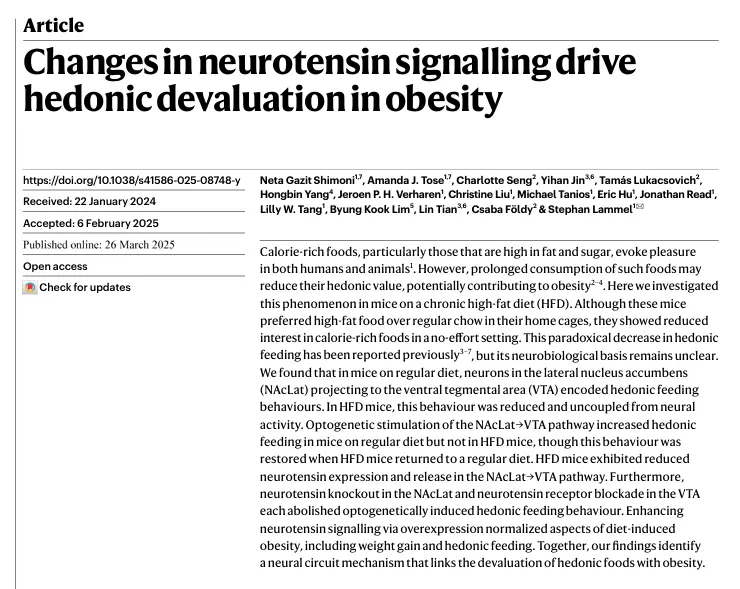
High-fat diets drastically reduce neurotensin release in this pathway, decoupling neural activity from eating reward. In contrast, enhancing neurotensin signaling via genetic approaches not only restored the reward response to food in obese mice, but also slowed weight gain and significantly alleviated anxiety-like behaviors.
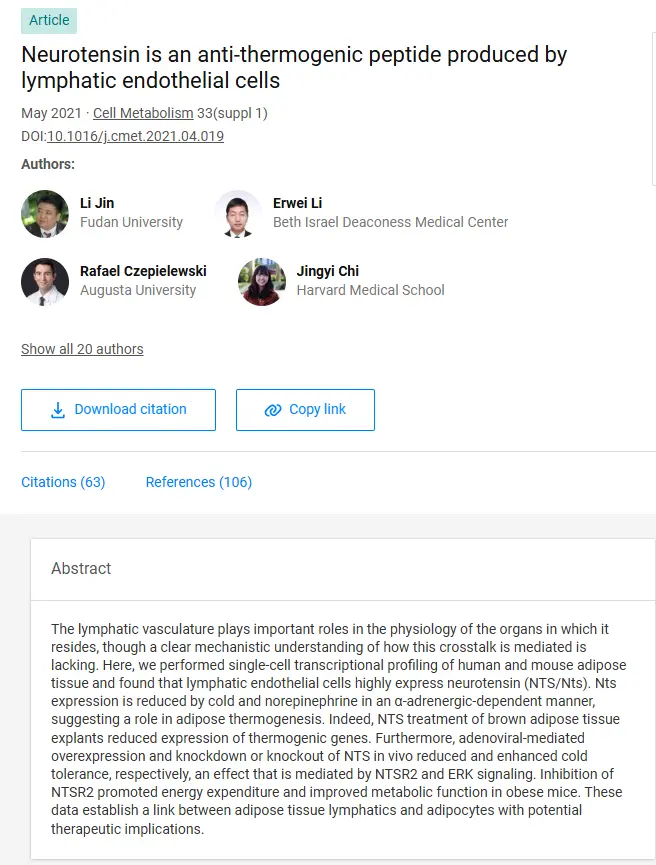
Another study published in Cell Metabolism in 2021 (with participation from a Fudan University team) uncovered its "hidden role" in metabolism: neurotensin is an anti-thermogenic peptide secreted by lymphatic endothelial cells in adipose tissue. Using single-cell transcriptomic analysis, the team found that lymphatic endothelial cells in adipose tissue highly express neurotensin. Its expression decreases when the body is exposed to cold environments or stimulated by norepinephrine—a change that correlates with the activation of thermogenic function. Direct experiments further confirmed: administration of neurotensin to brown adipose tissue (BAT) inhibits the expression of thermogenic genes; whereas blocking its receptor NTSR2 significantly enhances energy expenditure and improves metabolic status in obese mice.
As a commonly used tool molecule in scientific research, the basic properties of neurotensin (55508-42-4) support ongoing studies: with a molecular formula of C78H121N21O20, its lyophilized form requires storage at -20℃ to maintain activity. It has been widely applied in mechanistic studies on obesity and neural regulation.
From being a "reward switch" in neural reward pathways to a "thermogenic regulator" in adipose metabolism, the functional network of neurotensin is being progressively elucidated. These findings not only deepen our understanding of the body's regulatory mechanisms, but also lay new groundwork for targeted therapies against metabolic diseases such as obesity.