




In the exploration of cancer therapy, "precision targeting" has always been the key to breaking through bottlenecks. As a chimeric p53 penetrating peptide, PNC-27 (CAS: 1159861-00-3) has gradually become a research focus in the field of basic science due to its selective cytotoxicity against cancer cells, and its unique mechanism of action has been gradually uncovered in numerous studies.
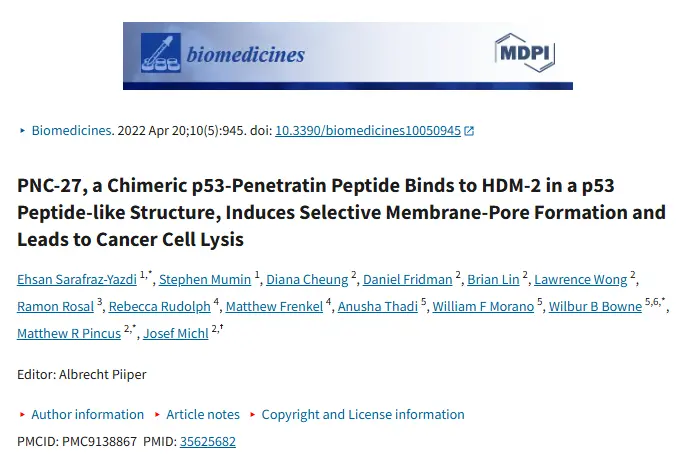
Unlike traditional chemotherapeutic drugs that tend to damage normal cells, the core advantage of PNC-27 lies in "precision recognition". Studies have shown that it exerts its effect by targeting the HDM-2 protein, a molecule specifically overexpressed on the membrane of various cancer cells but barely detectable on normal cell membranes. PNC-27 can adopt a conformation that binds to HDM-2; their combination induces the formation of pores in the cancer cell membrane, ultimately leading to cancer cell lysis and necrosis with no significant impact on normal cells. This mechanism has been validated in a study published in Proceedings of the National Academy of Sciences (PNAS), where researchers confirmed the specific binding mode between PNC-27 and HDM-2 through nuclear magnetic resonance and crystal structure analysis.
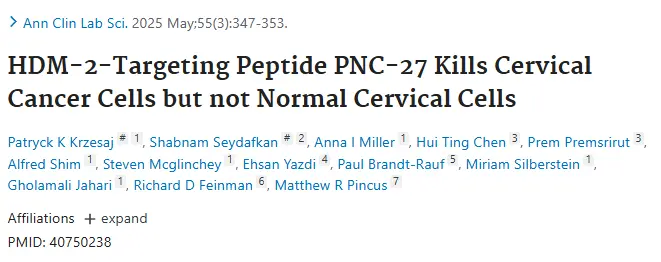
This selective cytotoxicity is not limited to a single cancer type. In cervical cancer cell studies, PNC-27 exhibited significant cytotoxicity against the HTB-35 cervical cancer cell line, with a half-maximal inhibitory concentration (IC₅₀) as low as 12.4 μM, while showing no effect on the normal cervical epithelial cell line PCS-480. This further confirms the core argument that membrane-bound HDM-2 is its primary target. In the field of non-solid tumors, PNC-27 can also induce necrosis in p53 gene-deficient K562 leukemia cells by binding to membrane-localized HDM-2, and this process is independent of the p53 pathway, offering a new strategy for the treatment of p53-mutant cancers.
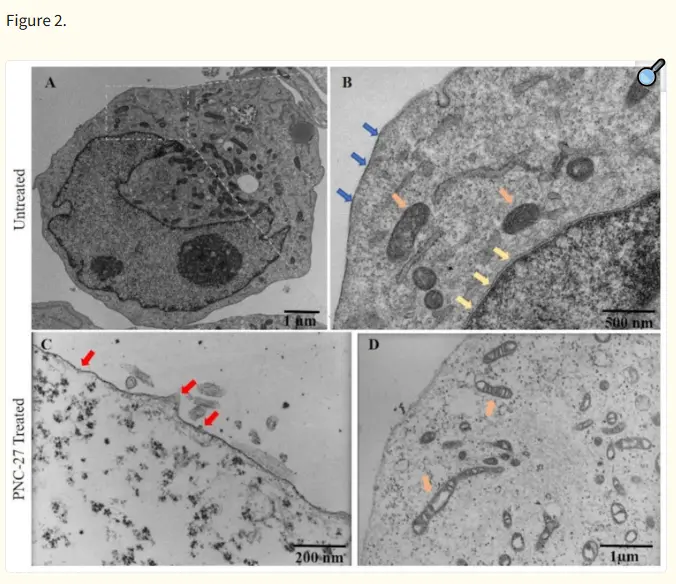
Positive results from in vivo experiments have further highlighted its research value. In a mouse model of acute myeloid leukemia, intraperitoneal injection of PNC-27 significantly reduced tumor cell engraftment rate and prolonged mouse survival without obvious toxic side effects. Electron microscopy observations revealed that PNC-27 forms a 1:1 complex with HDM-2, which assembles into annular pore structures on the cancer cell membrane. This morphological evidence has further improved the theoretical system of its mechanism of action.
From solid tumors to hematologic malignancies, and from in vitro cell experiments to in vivo animal models, PNC-27, with its HDM-2 targeting property and low off-target risk, provides an important template for the development of peptide-based anticancer drugs. With the in-depth research on combination therapy and drug delivery systems in the future, such precision-targeting peptides are expected to bring more breakthroughs to cancer treatment.