




Thymosin Beta-4 Fragment (1-4) (Ac-SDKP) Overview
Ac-SDKP (N-acetyl-seryl-aspartyl-lysyl-proline) is a naturally occurring tetrapeptide derived from the large thymosin beta-4 protein. Research in animal models has shown Ac-SDKP to have anti-inflammatory, pro-angiogenic, and anti-scarring properties. It has been proposed as a potential therapeutic agent for a variety of conditions, including cardiovascular disease, kidney and liver fibrosis, and inflammatory bowel disease. The peptide may even offer a more natural mechanism for the treatment of high blood pressure, in part due to its association with angiotensin-converting enzyme.
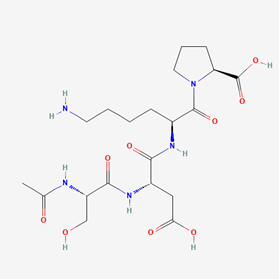
Summary of Characteristics
| Characteristic | Details |
|---|---|
| Chemical Sequence | Acetyl-Ser-Asp-Lys-Pro |
| CAS Number | 120081-14-3 |
| Molecular Formula | C20H33N5O9 |
| Molecular Weight | 487.51 g/mol |
| Other Known Titles | Ac-SDKP, N-acetyl-Ser-Asp-Lys-Pro, Thymosin Beta-4 Fragment 1-4 |
Mechanism of Action
At its most basic level, Ac-SDKP works by modulating the immune response. In animal models it has been shown to activate certain immune pathways responsible for bolstering anti-inflammatory responses, modulating the release of proinflammatory factors, reducing tissue infiltration by T-cells, and promoting the differentiation and migration of macrophages[1]. It is also known to suppress production of TGF-beta, which is a driver of fibrosis. This is likely the primary mechanism by which Ac-SDKP prevents the development of scar tissue.
It is important to note that Ac-SDKP is a natural derivative of thymosin beta-4 and is cleaved from TB-4, in the body, by the enzymes meprin-α and prolyl endopeptidase. TB-4 has long been known to have potent anti-inflammatory and anti-fibrotic activity[2]. Ac-SDKP can be produced synthetically and administered by orally and via injection. It is bioavailable in both forms, making it easy to administer to animal models.
Ac-SDKP: Anti-Inflammatory Effects
Research indicates that Ac-SDKP can attenuate the clinical symptoms of intestinal mucosal inflammation in animal models of inflammatory bowel disease, which are provoked by administering model intestinal irritants. While the exact cause of inflammatory bowel diseases, such as Crohn’s disease and ulcerative colitis, remains not fully understood, their prevalence is rising and appears to correlate with industrialization levels in various locations. Consequently, some speculate that irritants in food, water, or air may contribute to the development of inflammatory bowel disease in susceptible individuals. This is why Ac-SDKP has been proposed as a potential treatment and preventive for inflammatory diseases of the intestinal tract[3].
In mouse models, Ac-SDKP levels are lower in mice that lack the enzymes meprin-α and prolyl endopeptidase. Reduced levels of these enzymes have been linked to more severe inflammatory bowel disease, suggesting that the cleavage of Ac-SDKP from its parent thymosin beta-4 molecule is critical for controlling intestinal inflammation.
Research in these mouse models of inflammatory bowel disease indicates that Ac-SDKP’s activity is mediated through a reduction in MEK-ERK signaling. The MEK-ERK (Mitogen-Activated Protein Kinase/Extracellular Signal-Regulated Kinase) signaling pathway is crucial for cellular regulation, transmitting signals from the cell surface to the nucleus to induce changes in DNA expression. MEK-ERK is involved in cell growth and proliferation, differentiation, and metabolic regulation. Increased MEK-ERK activity has been associated with inflammation, cancer development and resistance to therapy, neurodegenerative diseases, and metabolic disorders such as type 2 diabetes.
MEK-ERK signaling is also important in regulating levels of transforming growth factor beta (TGF-beta). Research in heart disease indicates that TGF-beta drives the fibrotic process, leading to scar tissue development by converting fibroblasts into myofibroblasts. Ac-SDKP suppresses the differentiation of human cardiac fibroblasts into myofibroblasts, likely by inhibiting the TGF-β/Smad/ERK1/2 signaling pathway, thereby mediating its anti-fibrotic effects[4].
Ultimately, the anti-inflammatory activity of Ac-SDKP can be summarized in three bullet points.
- Inhibition of bone marrow stem cell conversion into macrophages
- Inhibition of activate macrophages and reduction in their migration into tissue
- Inhibition of the proinflammatory cytokine TNF-alpha
In other words, Ac-SDKP is a potent inhibitor of macrophage activity and macrophages are one of the primary drivers of fibrosis. This is likely the primary mechanism by which Ac-SDKP prevents and even reverses scarring and inflammation[1].
It is worth mentioning, before ending this section, that there is also evidence that Ac-SDKP inhibits oxidative stress and collagen synthesis that arises secondary to NADPH Oxidases[5]. NADPH oxidases are a family of enzymes that are well known generators of reactive oxygen species (ROS). Though they play important roles in normal physiology, their dysregulation in disease can lead to disastrous outcomes like stroke and heart attacks. These enzymes are also thought to play a key role in the development of preeclampsia in pregnant women. The regulation of NADPH oxidases has been a long-term goal of medicine as it has the potential to offer a host of disease-mitigating abilities.
Ac-SDKP: A Role in the Brain
Research in rat models of stroke indicates that treatment with Ac-SDKP, either alone or in combination with tissue plasminogen activator (tPA), can substantially decrease infarct volume and clinical neurological deficits without increasing the risk of bleeding. This effect is likely mediated through a reduction in several nuclear transcription factors, including NF-kappaB, TGF-beta, and plasminogen activator inhibitor-1. Together, these effects decrease microvascular fibrin extravasation and block the formation of scar tissue in the brain. The research also indicates that Ac-SDKP clearly crosses the blood-brain barrier (BBB) and can thus be administered systemically[16].
Interestingly, although Ac-SDKP crosses the BBB, MRI studies in rats provide evidence that it enhances BBB function in the setting of stroke and helps prevent disruption of this crucial layer of protection. This effect appears to reduce the deposition of fibrin into brain tissue[7].
Fibrin is a key component of blood clots and is derived from the larger fibrinogen molecule. Research shows that higher levels of fibrin are associated with an increased risk of stroke and with more severe long-term outcomes following stroke[18]. The ability of Ac-SDKP to regulate fibrin extravasation suggests it could be useful not only in the treatment of acute stroke but also in stroke prevention. Furthermore, levels of fibrin degrading products are heavily correlated with stroke severity[19][20], with higher levels predicting more severe long-term outcomes. Clearly, any intervention that can reduce fibrin activity in the brain would be beneficial for stroke treatment and prevention, making Ac-SDKP of great interest to neuroscientists.
Ac-SDKP: Summary
Ac-SDKP is a naturally occurring derivative of thymosin beta-4 that can also be produced synthetically. Research across various animal models indicates that this tetrapeptide is a potent regulator of scar formation in several organs, including the heart, liver, kidneys, and brain. Its anti-fibrotic activities have made Ac-SDKP of interest to researchers studying stroke, cardiovascular disease, and kidney disease. Additionally, Ac-SDKP has anti-inflammatory properties and helps regulate blood pressure. Its ability to modulate macrophage activity has been explored in conditions such as irritable bowel disease, chronic kidney disease, and in the treatment and prevention of stroke. This short peptide has demonstrated a range of beneficial effects in animal models and shows excellent oral bioavailability. Moreover, it crosses the blood-brain barrier, which enhances its versatility and ease of use.
Referenced Citations
- U. Sharma et al., “Novel anti-inflammatory mechanisms of N-Acetyl-Ser-Asp-Lys-Pro in hypertension-induced target organ damage,”American Journal of Physiology-Heart and Circulatory Physiology, vol. 294, no. 3, pp. H1226–H1232, Mar. 2008, doi: 10.1152/ajpheart.00305.2007.
- N. Kumar et al., “The anti-inflammatory peptide Ac-SDKP is released from thymosin β4 by renal meprin-α and prolyl oligopeptidase,”Am J Physiol Renal Physiol, vol. 310, no. 10, pp. F1026–F1034, May 2016, doi: 10.1152/ajprenal.00562.2015.
- Y. Shi et al., “N-Acetyl-Seryl-Aspartyl-Lysyl-Proline Mitigates Experimental Colitis Through Inhibition of Intestinal Mucosal Inflammatory Responses via MEK-ERK Signaling,”Front. Pharmacol, vol. 11, May 2020, doi: 10.3389/fphar.2020.00593.
- H. Peng et al., “Ac-SDKP inhibits transforming growth factor-β1-induced differentiation of human cardiac fibroblasts into myofibroblasts,”Am J Physiol Heart Circ Physiol, vol. 298, no. 5, pp. H1357–H1364, May 2010, doi: 10.1152/ajpheart.00642.2009.
- T. M. Frayling et al., “A Common Allele in FGF21 Associated with Sugar Intake Is Associated with Body Shape, Lower Total Body-Fat Percentage, and Higher Blood Pressure,”Cell Rep, vol. 23, no. 2, pp. 327–336, Apr. 2018, doi: 10.1016/j.celrep.2018.03.070.
- U. C. Sharma et al., “Galectin-3 marks activated macrophages in failure-prone hypertrophied hearts and contributes to cardiac dysfunction,”Circulation, vol. 110, no. 19, pp. 3121–3128, Nov. 2004, doi: 10.1161/01.CIR.0000147181.65298.4D.
- H. Peng et al., “Ac-SDKP Reverses Cardiac Fibrosis in Rats With Renovascular Hypertension,”Hypertension, vol. 42, no. 6, pp. 1164–1170, Dec. 2003, doi: 10.1161/01.HYP.0000104233.9300.96.
- P. Nakagawa et al., “Ac-SDKP decreases mortality and cardiac rupture after acute myocardial infarction,”PLoS One, vol. 13, no. 1, p. e0190300, Jan. 2018, doi: 10.1371/journal.pone.0190300.