




Abstract
AcSDKP (Acetyl-Ser-Asp-Lys-Pro) is a rare and valuable lead compound with significant antiproliferative activity. As an endogenous bioactive tetrapeptide, it shows no toxic or side effects. However, its rapid degradation in vivo limits its clinical application due to short biological activity duration. Structural modification of AcSDKP offers great potential for developing novel therapeutic peptides with improved stability and bioavailability.
1. Biological Background
AcSDKP is a natural tetrapeptide derived from the N-terminus of thymosin β4. It plays an important physiological role in protecting hematopoietic stem cells from radiation, chemical, thermal, and phototoxic injuries. In addition, AcSDKP regulates inflammation, inhibits fibrosis and apoptosis, and promotes angiogenesis — thus contributing to tissue repair. These multifunctional effects make AcSDKP a promising therapeutic target for diabetic nephrofibrosis and related fibrotic diseases.
2. Basic Information
Chinese Name: AcSDKP衍生物
English Name: AcSDKP
Company Code: GT-M3286
CAS No.: //
Sequence: Ac-SDKP-OH
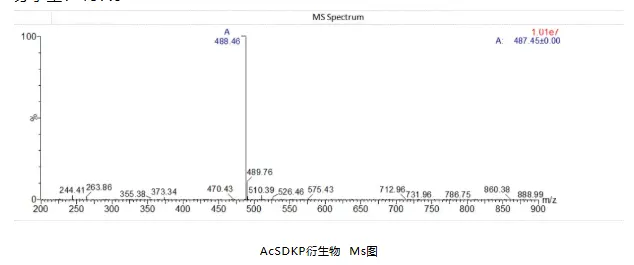
Molecular Formula: C20H33O9N5
Molecular Weight: 487.5
3. Structure–Activity Relationship (SAR) and Derivative Design
Rational structural modification of AcSDKP can preserve or enhance its biological activity while improving resistance to enzymatic degradation and extending half-life. Studies indicate that substitution of polar amino acids in the native sequence—such as replacing Asp with Glu or Lys with Arg—significantly reduces activity. Protecting the hydroxyl group on Ser or the amino group on Lys also abolishes activity, emphasizing the essential role of these side chains. The minimal sequence required to maintain biological activity is SDK.
4. Modification Strategy
Given the small molecular size of AcSDKP, various N-terminal protective groups with different polarity and steric properties were introduced to improve stability. Experimental results demonstrate that modifications at the C-terminal Pro or N-terminal Ac positions have minimal effect on activity. Importantly, all AcSDKP analogs showed no cytotoxicity, making them promising candidates for further preclinical research.
Through these structural optimizations, AcSDKP derivatives are expected to serve as potential hematopoietic stem cell protectants, suitable for preventing chemical or radiation-induced damage, or as adjuvant therapies in cancer treatment.
5. Significance of Peptide Modification in Drug Discovery
With advances in medical science and pharmaceutical chemistry, numerous peptide-based compounds have been identified in recent decades, showing excellent activity in anti-tumor, antiviral, neuroregulatory, immune-modulatory, and endocrine-regulating functions. However, naturally occurring peptides are often prone to enzymatic degradation, which limits their direct therapeutic use.
Chemical synthesis and structural modification play a critical role in overcoming these challenges. Modified peptides often exhibit improved bioavailability and metabolic stability, leading to successful clinical applications. Examples include Octreotide (Sandostatin), Eptifibatide (Integrilin), Goserelin, and β-Casomorphin—all of which are derivatives of endogenous peptides. The success of these drugs demonstrates the feasibility and importance of peptide structure optimization for drug development.
6. Conclusion
AcSDKP is a multifunctional endogenous tetrapeptide with high therapeutic potential. By exploring structure–activity relationships and applying chemical modification strategies, researchers can design AcSDKP derivatives with enhanced stability and biological efficacy. This approach not only provides experimental support for developing hematopoietic stem cell protectants but also contributes to the broader field of peptide-based drug innovation.